Remote Control: how it works and how it saves money
Remote Control gives you control over your lights even when you're away. Combined with Spectoda Analytics, you can see exact costs, areas of waste, and real savings.
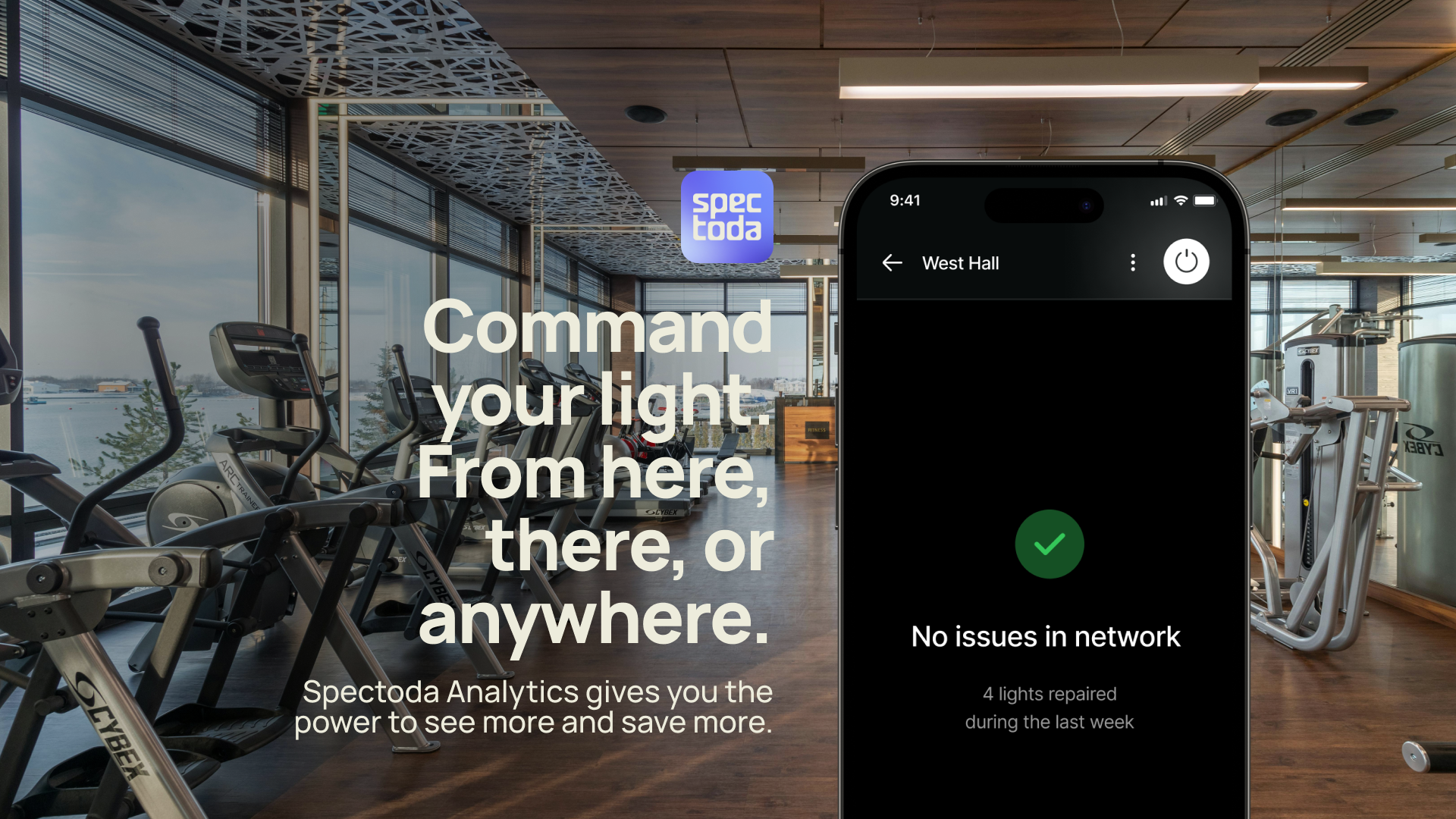
Lighting is one of the biggest operating expenses that can go unnoticed. Leave the lights on for an extra hour in several areas and you will see it in your costs at the end of the month. But without an overview and the ability to intervene quickly, lighting management often turns into guesswork.
Remote Control gives you control over your lights even when you're away. Combined with Spectoda Analytics, you can see your exact costs, where waste is occurring, and your actual savings.
What exactly does Remote Control mean and how does it work?
Spectoda is based on a wireless mesh network in which controllers communicate directly with each other. This makes installation flexible, scalable, and independent of a single central unit.
Once you add Spectoda Gateway to your installation, you connect your local network to the internet and Spectoda's cloud services. This gives you remote access to the same installation that you control on site. As with other Spectoda cloud features, remote control is available when Gateway is part of the installation.
The principle is simple:
- Controllers (connected to lights) form a mesh network in the building
- Gateway connects the installation to the Spectoda cloud
- Authorized users then manage and control the lights remotely
This means you are not dependent on being physically present in the building, hall, or facility. You can control the lights remotely.
Why is this important for facility management?
In larger buildings, the problem is not usually "how to turn on the lights." The problem is control and certainty:
- Are the zones lit as they should be?
- Are the lights on unnecessarily for too long?
- Do the settings correspond to actual operation?
- Do you know when and where to intervene without having to go to the site?
Without this, light management becomes reactive. Someone complains, you send a technician, they adjust something, and a month later it's back to square one.
Remote Control allows you to manage the installation on an ongoing basis, not after a problem has arisen.
How Remote Control saves time and money
Remote control is not a "convenience feature." For large installations, it is an operational saving.
1. Fewer service calls
You can resolve many situations remotely: check the status, adjust modes, and fine-tune scenes. Fewer trips, less coordination, lower service costs.
2. Faster response to changes and problems
When operations or modes change, or something isn't working, you don't have to wait for someone to get there. For large facilities, the speed of response is often the difference between a minor inconvenience and an operational problem.
3. Continuous optimization instead of one-time setup
Lighting is not set once and for all. The use of space, shifts, seasons, and layouts change. Remote access allows you to adjust dimming, times, scenes, and operating modes according to reality. And that's what creates savings.
When you want to not only control, but also know
The most powerful combination is Remote Control together with Spectoda Analytics.
Remote Control is the ability to intervene, and Analytics is the proof that the intervention makes sense.
Instead of guesswork, you always have information available about:
- the current status of lights and zones
- consumption and its development over time
- cost overview
- savings evaluation
- quick detection of zones where waste occurs
And most importantly, when you see a problem or deviation in Analytics, you can take immediate action. All in one Spectoda ecosystem.
When does Remote Control make the most sense?
Typically where there are:
- more zones or lights
- more floors, buildings, or branches
- responsibility for consumption and operating costs
- the need to respond without going to the site
- pressure for energy efficiency and operational reliability
For example: office buildings, warehouses, manufacturing, retail, schools, and public buildings.
Control and data together
Remote Control gives you the ability to intervene from anywhere. Spectoda Analytics adds data that lets you know where you are actually saving and where there is room for further optimization. Gateway then connects the entire system into a single functional unit.
The specific amount of savings depends on your operations, how you set up zones, and the quality of data from the project. We would be happy to show you how Remote Control and Analytics would work specifically for you.
Write to us and we will get back to you with a proposal.